
In 1761 a French scholar named Joseph de Guignes read a Chinese court history and concluded that China had reached America a thousand years before Columbus.
The text he was reading is real. The Liang Shu, compiled by Yao Silian in the seventh century, records that in the year 499 a Buddhist monk called Hui Shen arrived at the Chinese court with an account of a country he named Fusang, some twenty thousand li to the east. He described its people, its customs, its laws, and a tree from which the inhabitants made paper and cloth.
De Guignes did the arithmetic in the direction that interested him, pointed east across the Pacific, and arrived at Mexico.
It is worth being exact about what happened next, because the afterlife of this idea is more instructive than the idea itself.
In 1831 the orientalist Julius Klaproth took the account apart. Fusang, he argued, was Japan. The text mentions horses, and it mentions grapes, and neither belonged in a fifth-century description of the Americas. He also pointed at the distance. Twenty thousand li, by the measure of the period, comes to something in the region of five thousand miles — enough to reach a great many places, and not enough to reach Mexico.
The idea went quiet for forty years. Then in 1875 the American writer Charles Godfrey Leland revived it, and relocated Fusang to Mexico on the reasoning that Maya religion resembled Buddhism. That premise has not survived either.
The idea travelled even though the monk, in all likelihood, did not.
The modern scholarly view puts Fusang, if it was anywhere in particular, somewhere along the northern Pacific rim. "The most probable locations of Fu-Sang are still Karafuto, Kamchatka, the Kurile Islands, perhaps Japan itself," runs one summary of the position — Karafuto being Sakhalin.
That is the right answer and it is also a slightly deflating one, so it is worth saying what it rests on rather than leaving it as an appeal to authority. The deer-herding in the account belongs to the Asian side. So do the horses. And the distance, converted honestly, stops a long way short.
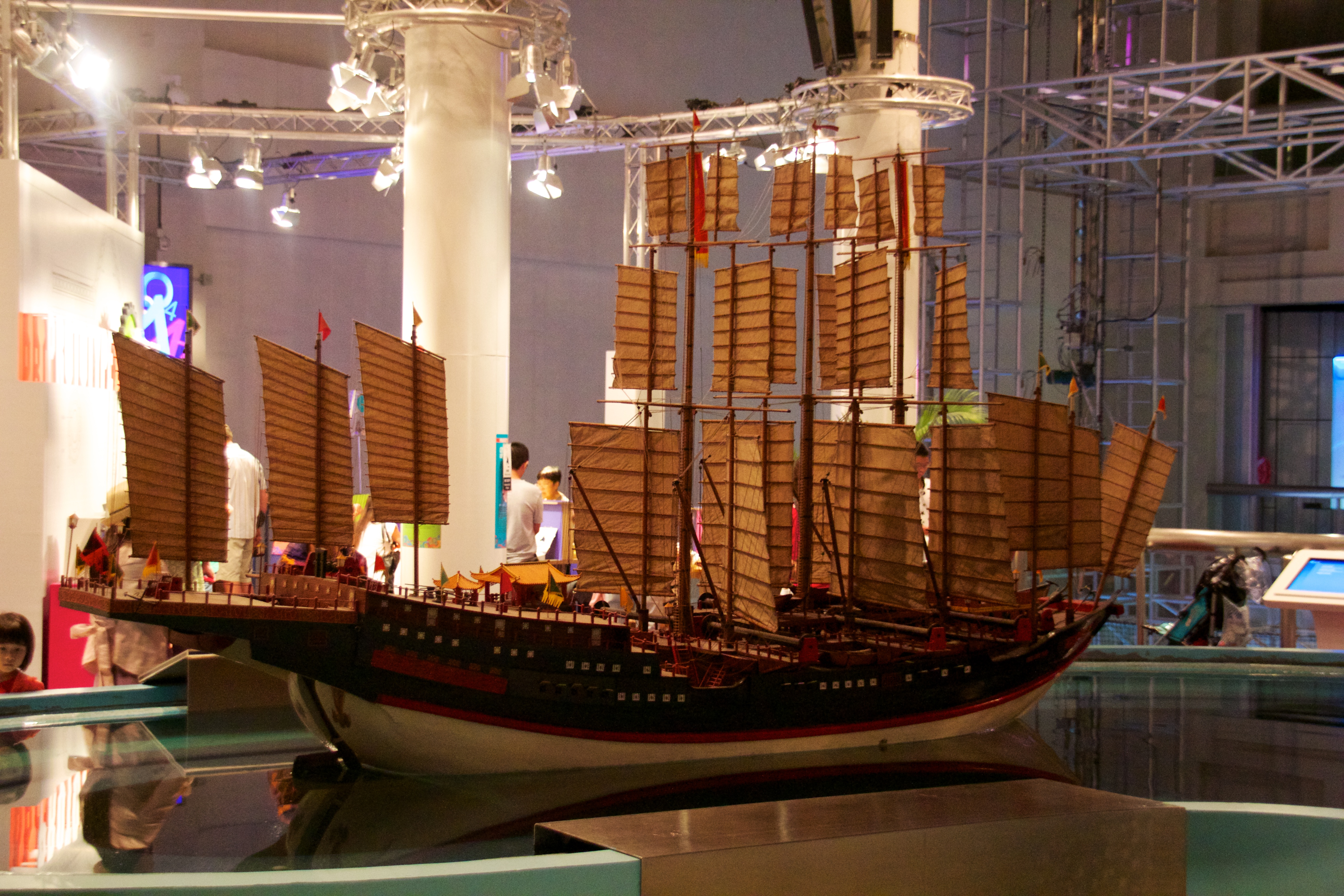
There is a separate claim, much more recent and much more widely sold, that a Ming treasure fleet under Zheng He reached the Americas in 1421. Zheng He is not in dispute: between 1405 and 1433 he commanded seven state expeditions of genuinely enormous ships through Southeast Asia, across the Indian Ocean, to Arabia and the coast of East Africa. The scale of those voyages is one of the facts of the fifteenth century, and European historiography spent a long time underweighting it.
The 1421 thesis is a different thing. It was published in 2002 by Gavin Menzies, a former Royal Navy submarine commander, and it has been rejected by sinologists and by professional historians essentially without exception. The critic Jason Colavito puts the objection at its shortest: "no documents exist and no artifacts have ever been unearthed" to support it.
That is the correct test and it is the one this paper would apply to any claim, including a flattering one. The argument runs on inference about what those fleets could in principle have done, which is not the same kind of claim as what they are recorded as doing.
This paper takes the view that both stories belong in the record, labelled correctly, and that labelling them correctly is the point.
Here is why they are worth keeping. European mapmakers put Fusang on their charts of America for the better part of a century, because a European scholar said a Chinese text described it. That is a real event in the history of cartography, and it means the Chinese account shaped how the Pacific was drawn whether or not anybody from the Liang Shu ever stood on this coast. The idea travelled even though the monk, in all likelihood, did not.
And the appetite for the theory on both sides of the Pacific says something that the theory itself does not. There is a wish, in China and among Chinese Canadians, for a presence on this coast older than the head tax and older than the railway — a claim on the place that predates the terms on which the place first admitted them. That wish is not evidence. It is, though, entirely comprehensible, and a paper that reported the theory without reporting the wish would be missing the more interesting half.
What is actually documented is enough to be going on with. Chinese ships, Chinese charts and Chinese navigation were the most advanced in the world for a long stretch of the second millennium. Chinese people have been on this coast since the gold rush of 1858, which is before British Columbia was a province and seventeen years before it finished arguing about joining Canada. That is a long presence, honestly dated, and it needs no monk.
Fusang stays where the evidence puts it, which is probably somewhere off the coast of Asia, and certainly in the history of what people wanted to be true.
This is the first in a continuing series on early contact and the stories told about it.
